
Product Overview
Water Hawthorne (Aponogeton distachyus) Lily-Like Aquatic Plant
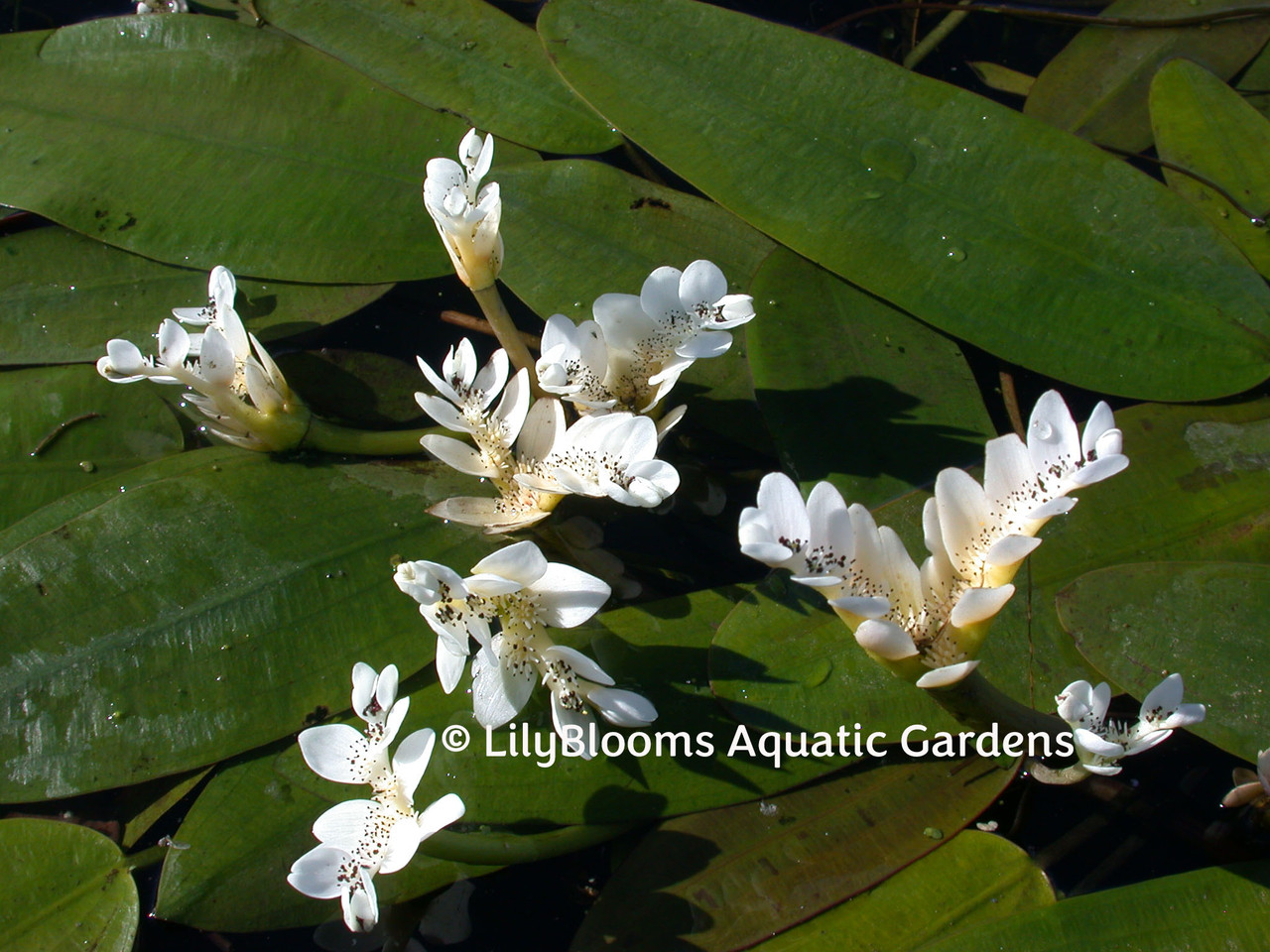
Water hawthorne are a delightful Fall, Winter and Spring blooming lily-like, and they are by far our most popular winter plant. Their forked white blooms have the delicious fragrance of vanilla, and bloom profusely in cool weather.
Water hawthorne grow in a similar fashion as water lilies, with long narrow floating leaves on stems attached to roots in soil at the bottom of the pond. They are smaller than standard water lilies, and multiply very slowly from tuber but quickly from seed.
Water hawthorne are extremely popular in mild climates, as they flourish in cool weather and provide foliage and blooms in winter when waterlilies are dormant; in fact, many pond owners companion plant them with waterlilies, as water lilies tend to be dormant in winter, and water hawthorne tend to be dormant in summer.
Water hawthorne are native to large very shallow lakes in South Africa which evaporate during their hot dry season, causing water hawthorne to form a tuber and go dormant; when rains come the lakes fill again, and water hawthorne quickly sprout and fill the lakes. The tubers are edible as well as the blooms, and in Africa the locals gather and cook the starchy tubers (we don't recommend this unless you have a surplus, as it is not good for the plant! But the flowers can be used as a fragrant garnish on a green salad and eaten as well...)
Water hawthorne leaves and blooms will withstand mild frosts and even thin ice; in colder weather the leaves and blooms will burn off, and return when the surface thaws. In Zone 7 there should be leaves and blooms most of the time; above Zone 7, there should be little if any interruption to blooming all winter. In very hot summer climates (such as Arizona) water hawthorne may be treated as annuals for winter use, although they may survive in a deeper part of the pond or in a shaded pond for the summer; they can also be partly dried, loosely wrapped in a plastic bag, and stored in a climate controlled area for the summer.
Not available to sell to the state of Washington.
Hardiness Zone: 6-10
Light Requirements: Full sun to part shade
Height: Leaves float on surface
Water Depth: 4" to 24"
Planting container: We recommend a 10" x 6" fabric pot to grow a regular sized plant, or using a 12.5" x 7" or 15" x 6" fabric pot to grow multiple specimen sized plants. Click on any fabric pot link to read about why fabric pots work better than hard plastic pots!
FERTILIZING: For best health and growth, we recommend fertilizing regularly (unless using the plants in a plant filtration system!). Use Pondtabbs 20 count, 60 count, or 300 count for fast release, or Aquascape 6 count or 12 count capsules for slow release (once a year) fertilizing. Aquascape is preferred for low maintenance, but Pondtabbs are useful in Spring when Aquascape is slow to start in low temperatures. Pondtabbs are also useful for a quick extra nutrient push for extra bloom, and for mid-summer fertilizing of a new plant (we don't recommend using slow release fertilizer in mid-summer or later in cold climates, as plants should run out of fertilizer at the end of the year to encourage dormancy in cold climates).
Plants are shipped bare root or in starter pots, and will require planting upon arrival. For in depth planting and care instructions visit our Planting and Care Instructions for Shallow Water and Bog Plants.
For information on using plants for pond filtration, please read our blog on this topic!