
Aquatic Iris for Ponds, Water Features and Terrestrial Gardens © 2024 Lilyblooms LLC
There are many species of iris, and most of these are definitely not aquatic. Bearded iris are the most popular terrestrial garden iris and require a dry dormant period—do not try these in water! That said, there are a surprising number of iris that evolved specifically to fill an aquatic niche in nature, and following is a list of these iris. Pleas note that all these iris are also suitable for terrestrial gardens, so long as the soil is kept from drying out.
These species and crosses are suitable for water features (pay attention to climate and water depth preferences):
Iris ensata (Japanese iris) are well known for regular as well as water gardens. The wild species blooms purple with narrow bands of yellow on the falls; it has been extensively bred into many cultivars and often sports extravagantly frilly blossoms with various colors. A variegated form has vertical green and white stripes; the variegation tends to fade as the season progresses. Iris ensata grows from 2 to 4 feet tall, depending on the cultivar as well as the amount of sun, water, and fertilizer it receives. They need loose, loamy soil that breathes easily, and don’t do as well in high clay soils. They tolerate sun to partial shade, with full sun being preferred in cooler climates and partial shade in hotter climates. They are listed as being hardy from Zone 4 through 9, although in the coldest zones they tend to do better in the garden than in the pond, and in the hottest zones they tend to suffer from the heat and will do best in partial shade and in the running water of a streambed to help keep them cool.
All cultivars love moist conditions during the growing season, so if keeping them as a terrestrial plant, give them lots of water. Iris ensata is not as water-loving as most aquatic iris, so don’t put their crown too deep under water, especially in the still water of a pond. All cultivars should perform well alongside a stream where they can get extra water. Most cultivars also do well in very shallow water in a moving stream (up to 2” deep), as the movement helps keep the soil “fresh” and oxygenated. Only a few cultivars tolerate the still water of a pond; some of the more tolerant ones include the wild species, ‘Hall of Marble’, ‘Murakumo’, and ‘Rose Queen’.
Iris ensata goes winter dormant; if keeping in standing water, we don’t recommend trimming leaves and stems back to below the water surface even if they appear dead, as even dormant foliage may help provide oxygen to the underwater roots.
Check out our Iris ensata cultivars for sale:
Iris ensata 'Anytus'
Iris laevigata (rabbit-ear or Japanese iris) are also from Japan, and are much more water tolerant than Iris ensata. In fact, their need for water is significantly higher, needing consistently moist conditions to be happy, and they enjoy having their crown submerged whether in streambeds or in the pond. In the mild coastal climate of California, Oregon and Washington they will perform well in a terrestrial garden if given lots of water, but in climates with hotter summers they should be in a marshy area or a water feature. Listed as being suitable for Zones 5 through 9, this species is even more sensitive to heat than Iris ensata, and may struggle in hot summers (partial shade and streambeds strongly recommended to enhance heat tolerance!). Iris laevigata also need loose, loamy soil that breathes easily, and don’t do as well in high clay soils. They tolerate sun to partial shade, with full sun being preferred in cooler climates and partial shade in hotter climates.
The wild species has blue-violet blooms in late Spring and early Summer, and may repeat bloom in later Summer and Fall. They get 2 to 3 feet tall, and leaves usually look good throughout the growing season. Iris laevigata cultivars have not evolved as large or as frilly blooms as ensata, but do have a couple different flower forms, and cultivars with blooms that range from blue to red-violet to white, and various color combinations with streaking or splashing. There is a strongly variegated form with vertical green and white stripes; these stripes are wider than in the variegated ensata, and the variegation remains strong through the season. Because the plant has less chlorophyll it is slower growing than the green cultivars, and perhaps less robust, but it is very striking.
Iris Louisiana species and hybrids are a group of 5 native Iris species that grow in and around Louisiana, as well as the many hybrids created by crossing these 5 hybrids. The cultivars from these crosses display a wide range of colors and flower forms, especially because of the large diversity of colors and forms found in nature and used in hybridizing. ‘Black Gamecock’ is well known for its dark, dark purple—almost black—blooms on a small plant, and there are a number of red cultivars. Worth remarking on is that there are a number of red blooming cultivars, but none are a “Lincoln Red Rose” kind of red; they come at their color from either a purplish ancestry or a coppery bronze ancestry, so will be more of a purplish red or a brick red. Very few of the species are offered for sale these days as their hybridized cultivars are so nice; an exception is Iris fulva, because it is by far the smallest of the Louisiana iris species, which fits well into small water features.
Due to the diversity of wild specimens there is a wide range of heights and growing habits of species and cultivars; they can range from less than 18” to over 60”. Two of the species have a range farther north than other LA species, and these have contributed to a lot of more winter-hardy cultivars. Most cultivars can live from Zone 4 or 5 to Zone 9 or 10, and tolerate heat and humidity well.
One negative aspect of LA iris that you won’t normally read about (because most sites are trying to sell them and don’t want to discuss downsides) is their foliage usually becomes unattractive after blooming, and it may be best to simply cut them back after blooming and allow them to grow fresh foliage. In warmer climates the LA iris will often have nice looking foliage in winter when most iris species are dormant, which may be more important to have in winter rather than in summer when most other plants are at their peak. Some cultivars seem to keep foliage attractive for longer than others; Iris LA ‘Blue Mystery’ is one of the best for foliage.
Check out our Louisiana iris cultivars for sale:
Louisiana Iris 'Black Gamecock'
Louisiana Iris 'Clyde Redmond'
Louisiana Iris 'Colorific'
Louisiana Iris fulva (species)
Louisiana Iris 'Red Velvet Elvis'
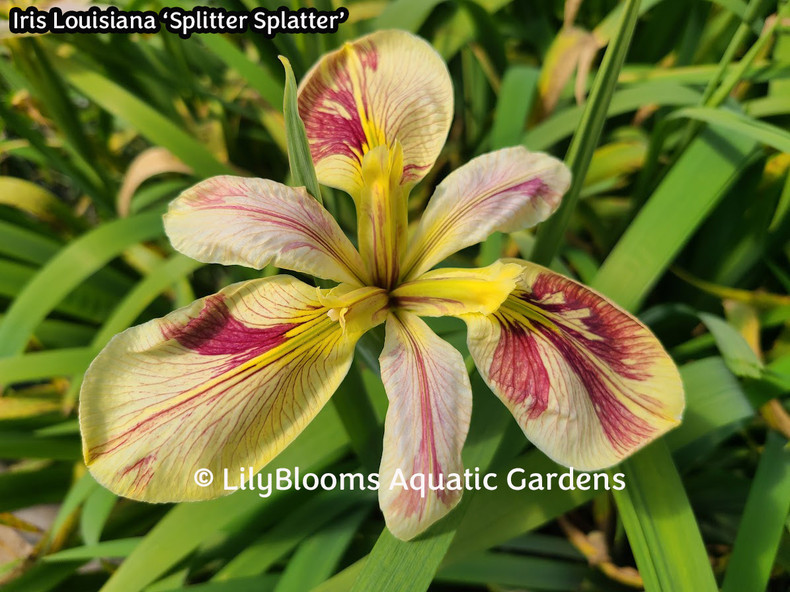
Louisiana Iris 'Splitter Splatter'
Iris pseudacorus (yellow flag iris) is the best known aquatic iris, native to Europe but introduced around the world centuries ago, including the United States. It has historical significance as well as sentimental value--the Iris pseudacorus bloom was the inspiration for the stylized fleur-de-lis, the national symbol of France.
Unfortunately, Iris pseudacorus is such a strong grower and a prolific spreader from seed that it has been declared a noxious weed in many states in the U.S. as well as in a number of countries, so we no longer carry it although it is still popular in states where it is still legal (and even in states where it is no longer legal, due to lack of knowledge and/or enforcement).
It has been a great favorite in this country and we would mourn its loss, except that fortunately this iris has been used extensively as a parent plant in crosses with iris ensata. We will go into detail in the next iris category; suffice it to say that anyone who liked Iris pseudacorus will like Iris pseudata (pseudacorus x ensata) even better. This cross embodies the best of both species, including better blooming and a huge selection of colors and forms compared to the Iris pseudacorus species.
However, there are at least 2 offspring of Iris pseudacorus worth mentioning. Iris ‘Berlin Tiger’ is a superior bloomer whose flowers are heavily striped and overlaid with brown. Iris ‘Roy Davidson’ is also a superior bloomer with yellow flowers that have a longer blooming season; its leaves emerge earlier than the species, and have a waxier, more glossy appearance. A huge improvement over the species is that Roy’s seeds are sterile, so it isn’t a nuisance seeder.
Iris pseudata (pseudacorus x ensata). This group of iris hybrids are relatively recent and relatively unknown, but they are an exciting new category of aquatic iris that are the most versatile, attractive, and robust of all aquatic iris, and combine the best characteristics of both species while being predominately sterile. Excellent as terrestrial garden iris, they form great clumps with many blooms, and foliage that usually remains attractive through the entire season. Some cultivars have foliage that emerges a chartreuse green in the Spring, and slowly turns a deeper green as they grow. Superb as pond or streambed iris, puseudatas love moist spots to standing water.
Pseudatas bloom a lot more than pseudacorus while inheriting its robustness, hardiness, and tolerance for water, while inheriting a large range of bloom forms and colors from ensatas.
Most pseudatas come in heights of tall and taller, with the most height gained in standing water and partial shade. There are some of medium height, and some short forms are now available, so you can pretty much dial in the height you want. Pay attention to the heights listed in the cultivar descriptions, as these can vary from under 18” to over 60”; if they really like the conditions, they have been known to get taller! The smallest forms tend to not be as robust, which is fine as the smallest cultivars are usually intended for smaller water features, where their slower growing habit is considered an advantage. Most cultivars will grow from zone 3 to Zone 10—they are very hardy and adaptable. The foliage is winter dormant.
Check out the Iris pseudata cultivars we have for sale:
Iris pseudata 'Antique Brass'
Iris pseudata 'Cascadian Snow'
Iris pseudata 'Roryu'
Iris pseudata 'Shiryukyo'
Iris pseudata 'Yukiyanagi'
Iris siberica (Siberian iris) aren’t usually listed as an aquatic iris, but they love moist conditions and many growers have found them to be aquatic in shallow water (up to 2” over the crown) in Zones 5 through 8. In terrestrial gardens, most Siberian iris can grow in Zones 3 and 4 as well. They have a simple flower form in a range of colors, and grow quickly into an attractive clump with narrower leaves, resembling a clump of grass as much as a clump of iris. The foliage is winter dormant.
Iris versicolor (blue flag iris, Northern blue flag) are native to the Northeastern US, mostly from Virginia into Canada. Blue to blue-violet blooms with yellow patch on the signals, although there are cultivars selected from the wild that can range from pink to a darker purple. Blooms on versicolor tend to be held higher above the leaves than on virginica. Foliage is generally attractive through the season, and goes dormant in winter.
Plants clump nicely, and get around 24 to 30” tall. Good in terrestrial gardens so long as they are well watered, virginicathrive in very moist soils or shallow water, including the standing water of a pond. Versicolor is hardy in Zones 2 through 7; with a little help in dealing with the heat, such as planting in streambeds and/or in partial shade, their range may extend into Zones 8 and 9.
Check out the Iris versicolors we have for sale:
Iris versicolor 'Purple Flame'
Iris virginica (Southern blue flag iris) are native to the Southeastern US, mostly from Virginia to Florida. Blue to blue-violet blooms with yellow patch on the signals. Good in terrestrial gardens so long as they are well watered, virginica thrive in very moist soils or shallow water, including the standing water of a pond.
Very similar to Iris versicolor, they tend to be taller with an extended growing season, as they have adapted to a warmer climate. In Southern states they may not really experience dormancy, but rather be more or less evergreen. In these states they do benefit from being cut back after blooming, letting them grow fresh foliage. Hardy in Zones 5 through 9.
Check out the Iris virginica cultivars we have for sale:
Iris virginica 'Contraband Girl'
Iris x Robusta (versicolor x virginica cross). These may be man-made crosses or may also come from natural crosses in the wild, as the range of these two blue flag iris overlap. Generally similar to their parents, but are worth noting because they sometimes have darker flowers, and may also have a strong purple color on new growth, which at some point will fade from the leaves as the season progresses. Cultivars of this cross that display the purple spring coloration include Dark Aura, Gem Dandy, Gerald Darby, Purple Knees, Purple Fan, and Mountain Brook. Gerald Darby has purplish flower stems, and Dark Aura has even darker stems, with a darker purple flower as well.
A very new introduction is Iris versicolor ‘Purple Flame’. This extraordinary iris has been introduced as an Iris versicolor selection, although we suspect that it may actually be a Robusta cross due to its extremely strong purple foliage in Spring. Its blooms are held above the leaves like a versicolor, and it was a chance seedling at a botanic garden in Delaware outside the normal range of virginica, but after all…it is a botanic garden, and we think this may be the strongest purple foliage coloration in all the blue flag family. Parentage aside, Purple Flame is a great new blue flag that is sure to become one of the most popular aquatic iris!
Check out our Iris x Robusta crosses for sale:
Iris x Robusta 'Dark Aura'